
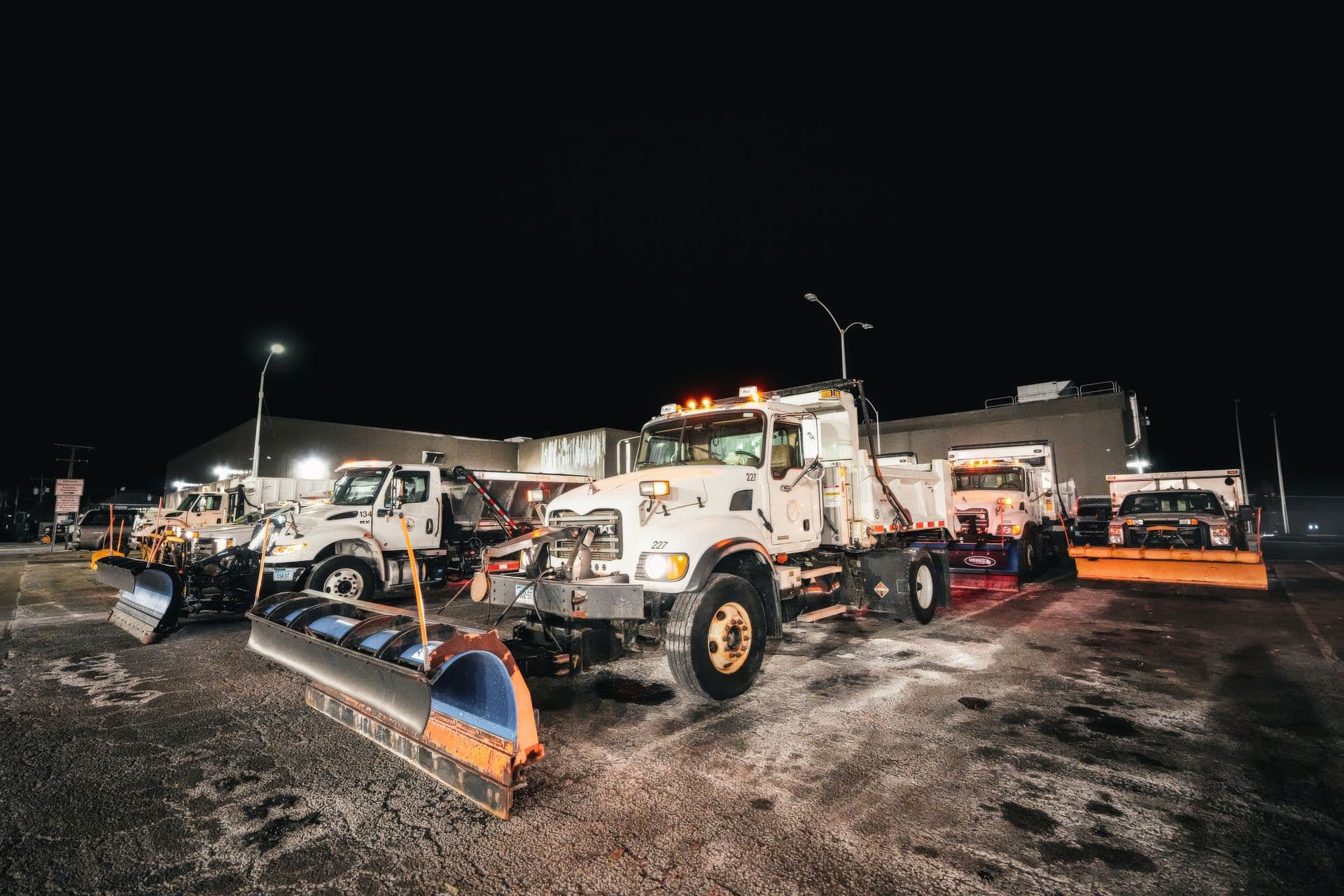
Commercial snow removal is a strange business. You sell a promise in September for weather you can't predict, deliver it in the dark while your customers sleep, prove it with records because the evidence melts, and find out in April whether the whole season made money. Few industries pack sales, logistics, staffing, documentation and finance into such a compressed, high-stakes loop.
This guide walks that whole loop, start to finish. Each stage links to a deeper article; together they're a season's operating manual for a commercial snow operation, whether you run three trucks or thirty plus subcontractors.
Table of Contents
- The commercial snow year at a glance
- Stage 1: Win the work (autumn)
- Stage 2: Build the machine (pre-season)
- Stage 3: Run the storm (winter nights)
- Stage 4: Prove the work (every morning after)
- Stage 5: Get paid (continuously)
- Stage 6: Learn the season (spring)
- Conclusion and next steps
The Commercial Snow Year at a Glance
The year has six stages, and the defining fact of the business is that each stage's quality is decided by the one before it. Storm nights go wrong in the pre-season build; billing disputes are lost at the site walk; next year's margins are set by whether this year was recorded. Keep that causality in mind through everything below: in snow, you're always working one stage ahead of where the problem will appear.
Stage 1: Win the Work (Autumn)
Commercial contracts are won on professionalism before price. Walk the site with the property manager, understand where the snow goes and which corners ice over, then measure the property by drawing its service areas on a map: the drawings produce the square metres, the square metres meet your price tiers, and the bid becomes a structured digital offer instead of a number in an email. Set the terms that survive winter: triggers, completion windows, frequency caps with overflow rates, documentation promises, liability boundaries.
The full method, from site walk to tier tables to the offer that activates the property on approval, is in How to Bid and Price Commercial Snow Plowing.
Stage 2: Build the Machine (Pre-Season)
October is when winter is actually run. Before the first flake, a commercial operation needs:
- Properties with data attached: drawings per work type, keycodes, completion times, contacts, and the service rules that encode each contract (no-service windows, visit caps per week or season).
- Routes per work type, in driving order, tested in daylight, with crews assigned. Salting routes and clearing routes are different routes; the reasoning is in the route planning guide.
- Zones for your districts, so a whole area can be dispatched in one press when the forecast turns.
- Subcontractors onboarded: agreements written, areas assigned, their people and machines connected to your system rather than to your phone. See Managing Snow Removal Subcontractors.
- Failure plans on paper: the dead truck, the sick driver, the storm beyond capacity, the subcontractor no-show. Decided in October, these are procedures; improvised in January, they're emergencies.
Stage 3: Run the Storm (Winter Nights)
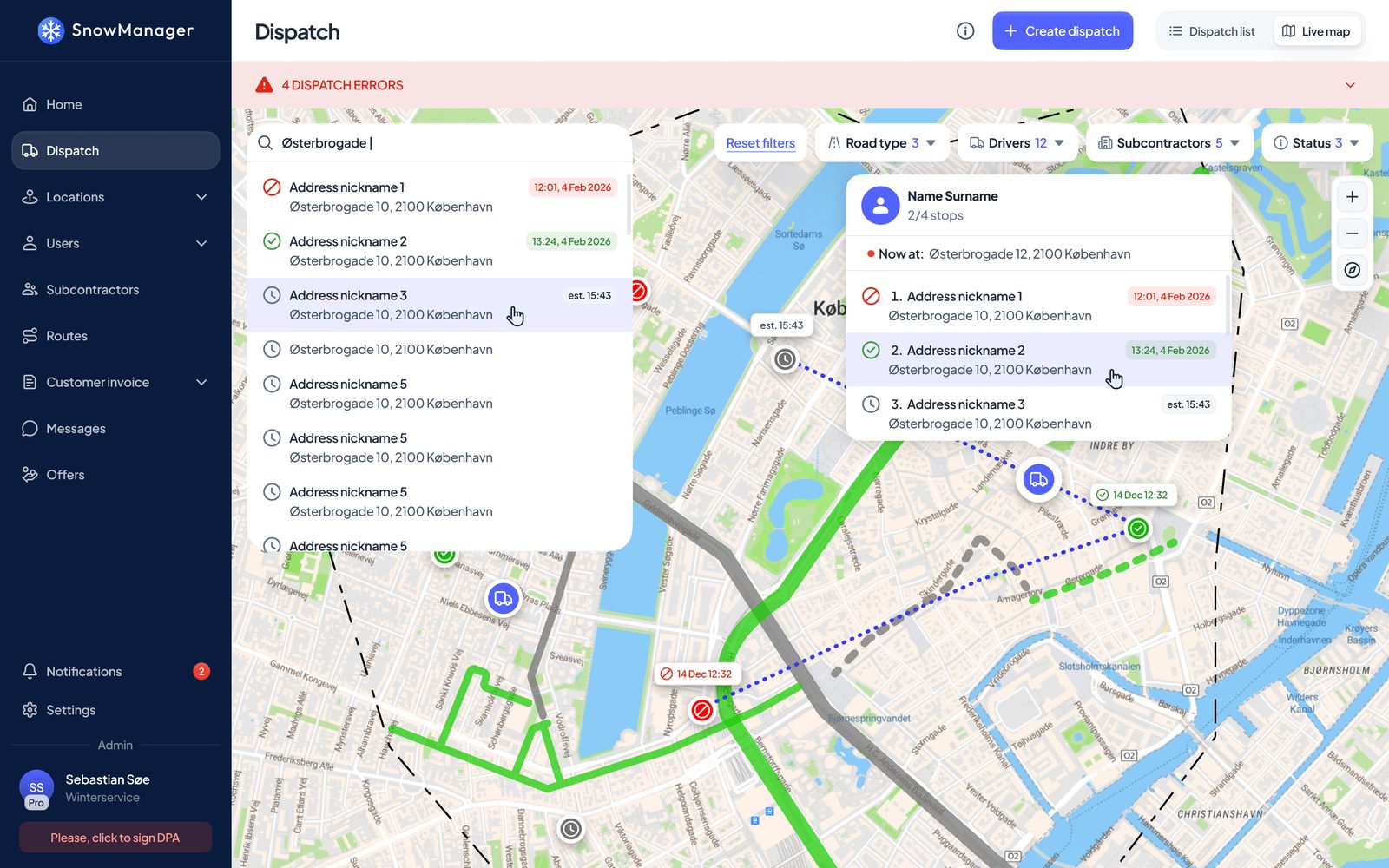
The storm night itself should be almost boring, because everything was pre-decided. The weather call is made; dispatch goes out by route or by zone, and the system applies every contract rule automatically, drops what mustn't be serviced tonight, invites every crew and subcontractor, and refuses to let overlapping dispatches double-book the same address. Drivers accept on their phones, drive their stops, and the live map shows the whole night moving: which stops are done, which crew is where, which subcontractor has accepted their slice.
The office's job shifts from launching work to handling exceptions: the blocked lot, the breakdown, the extra call-out routed to whoever's nearest. Deep dives: Snow Removal Scheduling Software for the dispatch machinery, and The Best App for Snow Plowing Crews for the cab side.
Stage 4: Prove the Work (Every Morning After)
Snow removal's product is invisible by 9 AM, so the record is the product. Commercial-grade proof of service means every stop carries automatic GPS check-in and check-out (stamped by the property's drawn geozone, not by a driver remembering to tap), the outcome, the driver's note, and photos taken in the app. How the tracking works, and why the drawn service area is the right definition of "arrived", is covered in Snow Plow Tracking: GPS That Proves the Work.
For commercial customers, put the record where they can see it: a customer portal showing their properties, the planned work, each visit's times and photos. Property managers stop calling for status; disputes shrink to lookups; and at renewal time, the portal is your case. The wider documentation discipline is in Invoicing and Proof of Service Done Right.
Stage 5: Get Paid (Continuously)
In a well-built operation, billing isn't a stage at the end; it rides along all season. Confirming each completed dispatch drafts the invoice lines from the recorded work: per-visit sites line by line, hourly sites from the recorded times, seasonal contracts as scheduled instalments, with duplicate flags and no silent zeroes. The month's work collects on one reviewed draft per customer, sent straight into accounting, while subcontractor settlements draft from the same completed stops so both sides of every visit always agree.
The mechanics, safety nets and vendor questions are in Snow Plowing Billing Software: What to Look For.
Stage 6: Learn the Season (Spring)
April is when next winter's margin is made. With a season of recorded data, the review is straightforward:
- Per site: recorded time versus quoted time, visits driven versus visits assumed. Fix mispriced tiers, mis-scoped drawings, and contracts whose terms didn't survive contact.
- Per route: which ones consistently ran long, where the order fought the geography.
- Per subcontractor: cost against revenue, response reliability, documentation quality.
- Per dispute: every one was a data gap, a route problem, or a contract hole. Close it before autumn.
Field note: the operations that compound year over year aren't the ones with the biggest fleets; they're the ones where April actually talks to October. If the season ended and nothing about your tiers, routes or contracts changed, the review didn't happen.
Then the loop closes: renewals go out with better prices on better data, the machine gets rebuilt a little sharper, and the first flake of next season lands on an operation that has already run it once on paper.
Conclusion and Next Steps
Commercial snow removal rewards the operator who treats it as one connected system: contracts that anticipate the 2 AM reality, a pre-season build that makes storm nights procedural, execution that records itself, billing drafted from the record, and a spring review that feeds it all back. Every stage covered here runs on data the previous stage produced, which is the real argument for running the whole loop on one platform instead of a patchwork; that argument, category by category, is What Software Do Snow Plowing Companies Use?
SnowManager is that loop in one system: offers, properties, routes, zones, dispatch, tracking, portal, billing. Book a demo and we'll walk your operation through all six stages, or start with pricing.